Jev is TypeSafe AI’s first public System One model. It is designed for decision points inside software: provide context and a question with a defined answer format, then use the result in your application.
What does it return?
Rather than writing an explanation, Jev returns structured judgments and probabilities. Its interface supports selecting among options, rating something against an ordered rubric, and evaluating a yes/no statement.
TypeSafe describes its training approach as Reinforcement Learning for Calibrated Decisions (RLCD). The company also says Jev computes probabilities in parallel instead of generating an answer token by token. These are the developer’s descriptions; this note is not an independent evaluation of its architecture or performance. Source: TypeSafe’s introduction
An example: routing a support request
Imagine a customer message arriving in a support system. The application supplies the message and a set of possible destinations:
- Billing
- Technical support
- Delivery support
A decision model estimates which destination fits. Application code can then route the request or send an uncertain case to a person for review.
This is an illustrative workflow, not a tested Jev integration. The useful separation is that the model supplies a judgment; code controls the action. A more complex agent could use a decision model for routing and another model for writing a response.
How the workflow fits together
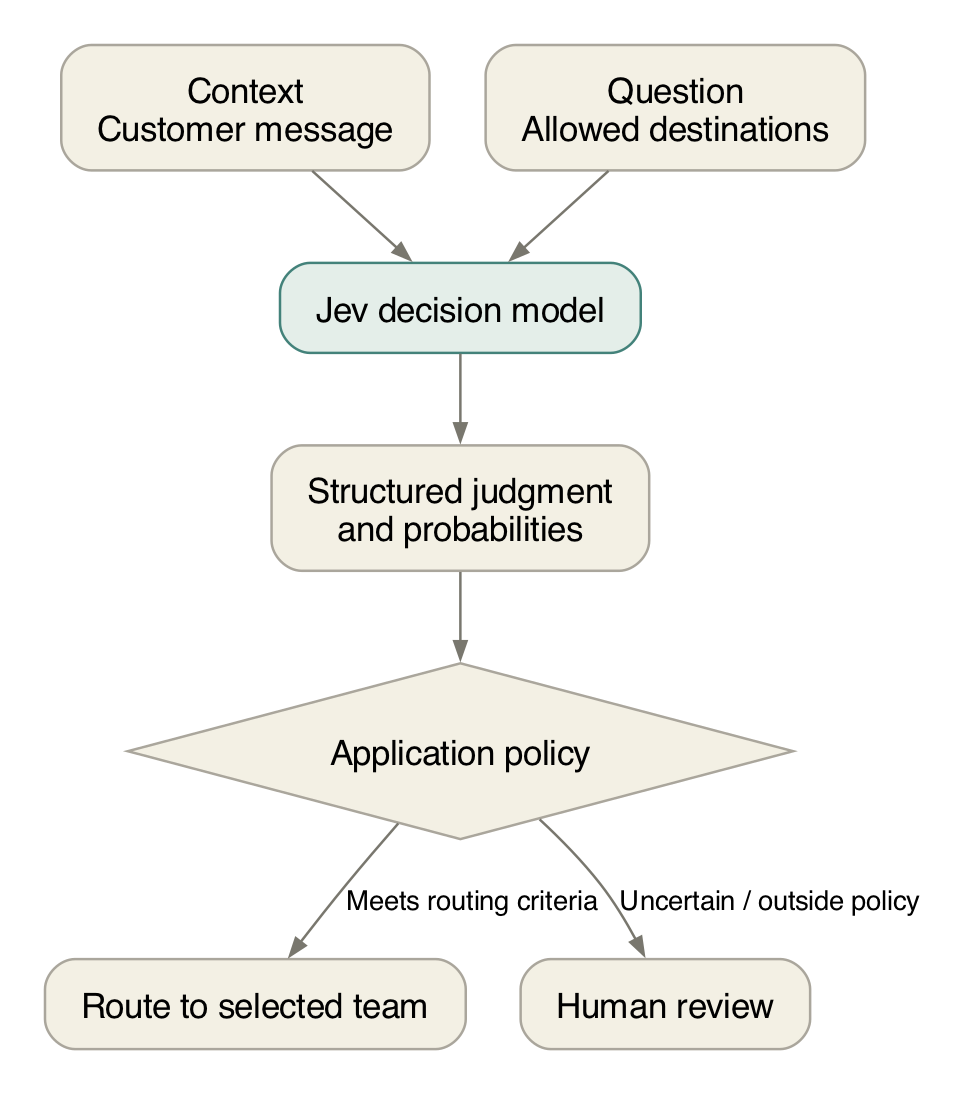
Illustrative support-routing workflow. The application defines the routing criteria; this diagram does not prescribe a probability threshold.
A valid answer can still be wrong
Restricting the answer format avoids the problem of parsing unrestricted prose. It does not establish that the selected option is correct or that a reported probability is reliable on your own data.
An October 2026 preprint investigating Jev reports weaknesses on tasks that benefit from explicit intermediate reasoning. Its findings suggest that a one-pass decision model should not be treated as a replacement for every reasoning workflow. Source: What Can’t Jev Decide?
For a real application, evaluate accuracy and calibration on representative examples, include ambiguous cases, and compare against a simple classifier or rules where those are plausible alternatives.
Questions to explore
- When does a decision model outperform a conventional classifier?
- How stable are its probabilities when the wording of the options changes?
- Can it route between agent tools reliably enough to justify its cost?
Research summary based on the linked sources, checked November 1, 2026. No hands-on benchmark is claimed.